 Covenant Canyon
November 13, 2026 — Stand With Yah Ephesians 4:11–16
Morning Focus Question: How can we remain firm in truth without abandoning love?
We began by examining who gives the callings within the body of Christ. Yah establishes the order, and not everyone is called to the same position or entrusted with the same responsibility. Some are called to lead, some to teach, some to prophesy, and some to evangelize. Each has a different function, but all are working for the same body. A title means nothing without the One who calls us into that position.
Those entrusted with leadership are responsible for equipping the saints, not creating dependence upon themselves. Just as muscles weaken when they are never exercised, our spiritual discernment remains undeveloped when we depend entirely on someone else to read, study, and explain the Word. We must learn to open our Bibles, ask questions, pray, and seek understanding for ourselves. A person who trains their body gradually develops the strength to carry heavier weight. In the same way, studying and applying Scripture prepares us to recognize deception and stand firm when the enemy attempts to lead us astray.
The fruit of spiritual leadership is not measured by the number of people filling a building, but by the lives of those being taught. Are they growing in faith? Are they helping others? Are they walking in obedience? Are they developing their own relationship with Yah? A pastor is entrusted with a flock, not merely an attendance count. The purpose is to strengthen the members so they can fulfill their own responsibilities within the body.
As we mature, we grow toward unity in faith and knowledge of Yeshua. We are not meant to be divided by race, gender, titles, or positions. We are one body, and how we treat one another reflects how we treat Christ. Feeding the hungry, clothing those in need, offering shelter, and helping someone who has stumbled are expressions of that love. We know how painful it feels when we believe we have been forgotten, yet Yah has not forgotten us. Even in His silence, we continue praying, trusting, and seeking understanding. His silence may be preparation or protection, but we do not know His plans or His ways, and we cannot demand that He answer according to our expectations.
That same love must guide how we speak the truth. Loving someone does not mean encouraging decisions that will harm them or remaining silent when they are being led astray. But speaking truth does not give us permission to humiliate, seek revenge, or intentionally wound another person. Correction should come from a desire to restore, not destroy. We are not called to prove ourselves right at the expense of someone else's well-being. We are called to help one another find our way back to the Father.
The body of Christ functions like the human body. The eye sees, the ear hears, the legs move, and even the toes have their purpose. Each part depends upon the others. Yeshua is the Head, Yah sustains all life, and Ruach HaKodesh works within the body. No member is without purpose, and no function is too small to matter. Every part is necessary, and every member carries responsibility for the well-being of the whole.
We are one body with many functions, called to stand firm in truth, grow in discernment, strengthen one another, and walk in love.
Cross-Reference Trail — How Our Conversation Moved Through the Word
Primary reading: Ephesians 4:11–16.
The quotations below are questions and excerpts from the study conversation. The Scripture notes distinguish passages quoted during the conversation from passages only named or discussed. Some connections began with an observation rather than a question.
1) The One who places the members in the body.
Our opening discussion of Ephesians 4:11 concerned the One who gives the callings and places the members in the body. The connection introduced here was 1 Corinthians 12:18 — quoted in full.
The conversation then asked: “What do you notice about the fact that Paul says ‘some’ before naming each calling?”
2) Different callings within the same body.
Robin answered: “Because not everyone is called to do the same thing and everyone is not called with the same purpose to lead, teach, or prophesy, or evangelize.”
The response quoted 1 Corinthians 12:29–30, asking whether all have the same functions, followed by 1 Corinthians 12:17, concerning an entire body being an eye or an ear. Both passages were quoted.
3) Equipping rather than creating dependence.
After Robin connected Ephesians 4:12 to making sure the leg moves and the toes can wiggle, the conversation asked: “What happens to the body when someone entrusted to equip its members begins controlling their movements instead of helping them grow?”
Robin answered: “They become reliant on it and the muscles got weak.” She connected this with teaching someone to fish and learning to open the Bible and ask questions rather than depending on the pastor to learn and speak for them.
Hebrews 5:12–14 was named; only verse 14 was quoted, concerning discernment exercised “by reason of use.” For Philippians 2:12–13, verse 12 was quoted; verse 13 was discussed but not quoted. The connection was obedience in Paul’s absence and Yah working within believers.
4) Recognizing the fruit of equipping.
The conversation asked: “If the purpose of equipping is to strengthen the body, how would we recognize that a pastor or teacher is actually succeeding in that responsibility?”
Robin answered: “By the fruit that they bear. When a pastor or teacher is succeeding the body is growing and the fruit of the body is flourishing.”
Matthew 7:16 and John 15:5 were quoted. The conversation connected recognizing fruit with remaining in Yeshua, the vine, rather than treating the pastor or teacher as the vine.
5) Flourishing lives, personal shepherding, and Yah giving the increase.
The conversation asked: “Can a congregation be growing in numbers while the body itself is becoming spiritually weaker?”
Robin clarified: “Of course, when I say fruit flourish I don't mean numbers; I am speaking of the walk of the members of that church.” She spoke about souls being saved and people being helped, and asked: “Yah knows me by name why should I be a number to my pastor?”
John 10:14, 1 Peter 5:2–3, and 1 Corinthians 3:6–7 were quoted, in that order. They were connected to knowing the flock, feeding and caring for the flock rather than ruling over it, and planting and watering while Yah gives the increase.
Robin subsequently clarified her own preference: “I prefer smaller congregations my choice is not everyone's choice but it's mine”.
6) Unity in faith, not division over race or gender.
In Ephesians 4:13, the conversation turned to unity and knowledge. The question asked was: “What stands out to you?”
Robin answered: “Unity in faith, Father Son and Holy Spirit. Every knee will bow and every tongue will confess we will be one in the body not fighting over race nor gender”.
Galatians 3:28 and Philippians 2:10–11 were quoted. The first was connected with being one in Christ; the second followed Robin’s reference to every knee bowing and every tongue confessing.
7) How we treat others, practical care, and feeling forgotten.
Robin said: “Because how we treat one another is how we treat Christ.” She spoke about feeding, clothing, and sheltering others, then asked: “We are the examples of Christ and to walk past someone who is hungry means that Christ should walk past us when we are hungry?”
She also said: “Think about how we feel when we think Yah has forgotten us.”
Matthew 25:35–36 was quoted; the saying from Matthew 25:40 beginning “Verily I say unto you” was quoted as an excerpt. James 2:15–17 was quoted in connection with meeting someone’s physical needs rather than merely speaking to them. Isaiah 49:15–16 was quoted in response to the discussion of feeling forgotten by Yah.
8) Prayer and seeking understanding when we do not know His plans.
Robin said: “We don't know His plan nor His way so in times of silence we must pray, pray without ceasing because that silence may be preparation or it may be protection, we don't know but we can pray for understanding”.
Isaiah 55:8–9, 1 Thessalonians 5:17, and James 1:5 were quoted, in that order. The conversation moved from His thoughts and ways, to continuing in prayer, to asking for wisdom. Robin said silence MAY be preparation or protection; she did not claim to know the reason for a particular silence.
9) Examining teaching instead of being carried by it.
While reading Ephesians 4:14, the conversation returned to Robin’s earlier point about opening the Bible and examining what is taught. Acts 17:11 was quoted concerning the Bereans searching the Scriptures.
This reference was introduced before Robin’s weight-training illustration. The question at the end of the exchange was: “What are you seeing?”
10) Training, spiritual exercise, and recognizing the enemy’s tricks.
Robin compared daily study with training to lift a 100-pound weight rather than attempting it without preparation. She asked: “That's the same with your spiritual life, how can you fight the tricks of the enemy if you aren't even trained to see them or know how they come?”
Hebrews 5:14 was quoted again. Then 2 Corinthians 2:11 and Ephesians 6:11 were quoted concerning the enemy’s devices and standing against his wiles. This returns to the earlier Hebrews 5:12–14 passage; it is not a new reference in the index.
11) Truth spoken to restore, not to wound or seek revenge.
After Ephesians 4:15–16, the conversation asked: “What stands out to you about Paul's instruction to speak the truth in love, especially after he has just warned us about deceitful teaching in verse 14?”
Robin answered: “Speaking the truth in love is not to destroy or get revenge but instead to help someone out of the darkness that has tried to consume them.” She distinguished care from encouraging harmful decisions and asked: “Why do you seek to cause harm just to make yourself feel better?”
Proverbs 27:6, Galatians 6:1, John 7:24, and 1 Corinthians 13:2 were quoted, in that order. The connections were a friend’s faithful correction, restoration with meekness and self-examination, righteous rather than superficial judgment, and knowledge or gifts without love.
12) Helping someone find their way back.
The conversation asked: “When we're about to correct someone, are we more concerned with proving that we're right, or helping that person find their way back?”
Robin answered: “We are supposed to be concerned with helping others find their way back.” She connected this with one body and helping others find the Father.
James 5:19–20 and 1 Corinthians 12:26 were quoted. The conversation connected bringing someone back from error with members sharing one another’s suffering and rejoicing.
13) The Head, the heart, and the breath in Robin’s body illustration.
Robin said: “One body many functions just like the human body and each part is dependent upon the other to do its job. The brain being the head, Yeshua being the head and the heart is the control, Yah is in control and the spirit breaths, the holy spirit controls the breath”.
Colossians 1:18 and Proverbs 4:23 were quoted. Jeremiah 17:10 was explicitly referenced and paraphrased concerning Yah searching the heart, but was not quoted. Genesis 2:7 and John 20:22 were then quoted in connection with the breath of life and receiving the Holy Spirit.
14) Yah sustaining the entire body.
The conversation asked: “When you say ‘the heart is the control,’ are you thinking about Yah as the One who sustains the entire body, or about how He guides the hearts of its members?”
Robin clarified: “Yah sustains the entire body, all blood pumps through the heart and all life goes through Yah”.
Acts 17:28 and Colossians 1:17 were quoted. Genesis 2:7 was revisited in the explanation without being quoted again. Then 1 Corinthians 12:21 was quoted concerning one member not saying to another, “I have no need of thee.”
15) No insignificant member or function.
Robin concluded: “So now we understand that there are no small roles in the body of Christ everyone and everything has a purpose and function.”
1 Corinthians 12:22 and 1 Corinthians 12:25 were quoted. The conversation connected the members that seem weaker being necessary with members having the same care for one another.
Reference record: 38 distinct cross-reference entries, with the repeated visits recorded above. Ephesians 4:11–16 remains the primary reading; its quotation in the closing prayer is not an additional cross-reference.
Summary
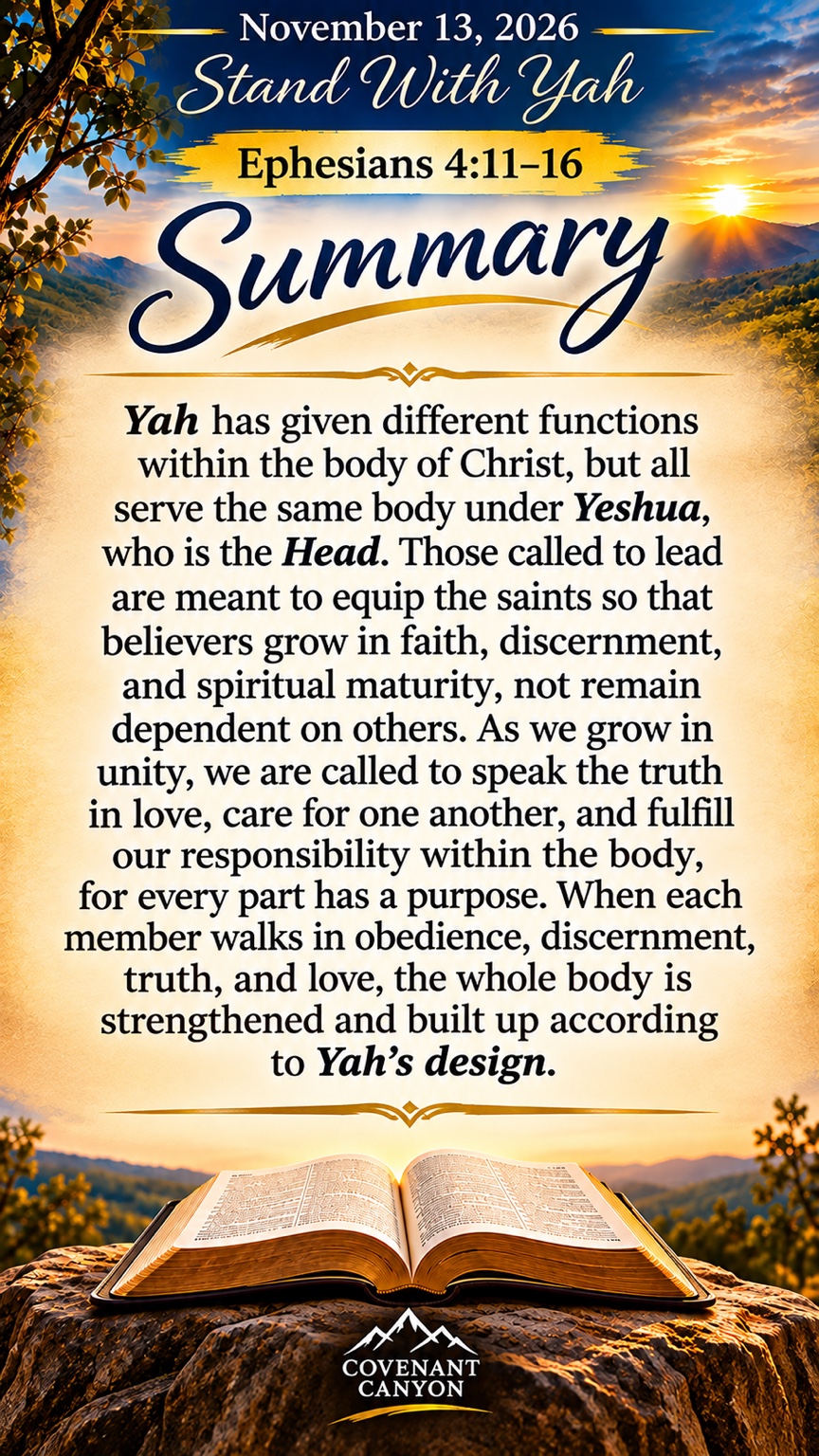
Yah has given different functions within the body of Christ, but all serve the same body under Yeshua, who is the Head. Those called to lead are meant to equip the saints so that believers grow in faith, discernment, and spiritual maturity, not remain dependent on others. As we grow in unity, we are called to speak the truth in love, care for one another, and fulfill our responsibility within the body, for every part has a purpose. When each member walks in obedience, discernment, truth, and love, the whole body is strengthened and built up according to Yah’s design.
November 13, 2026 — Stand With Yah Ephesians 4:11–16 | Reflection
How can we remain firm in truth without abandoning love?
As we examine our walk with Yah, we must also examine how we treat those walking alongside us. Are we helping others grow in their relationship with the Father, or are we expecting them to depend on us for their understanding? Are we exercising our own faith through studying the Word, prayer, and obedience, or are we relying on someone else to prepare us for battles we must learn to face? When someone stumbles, do we reach out to help them stand again, or do we use their mistakes as an opportunity to judge, embarrass, or condemn them? When we encounter someone hungry, hurting, or struggling, do we recognize our responsibility to show the love of Yeshua, or do we walk past because their circumstances are not our own? And when Yah is silent in our own lives, do we continue trusting and seeking His wisdom, remembering that we do not know His plans, or do we allow unanswered prayers to make us question His love? We cannot expect the body to be strengthened while neglecting our responsibility to its members. Each of us has a purpose, but that purpose is never separate from our responsibility to love, serve, and strengthen one another. As we continue growing in faith, let us examine not only whether we know the truth, but whether the way we live and share that truth reflects the love of the One we profess to follow.
Ending Question
Are we strengthening the body of Christ through our faith, discernment, obedience, truth, and love—or are we expecting the body to function while neglecting our own responsibility within it?
Stand for Truth in Love
Ephesians 4:11–16 Prayer
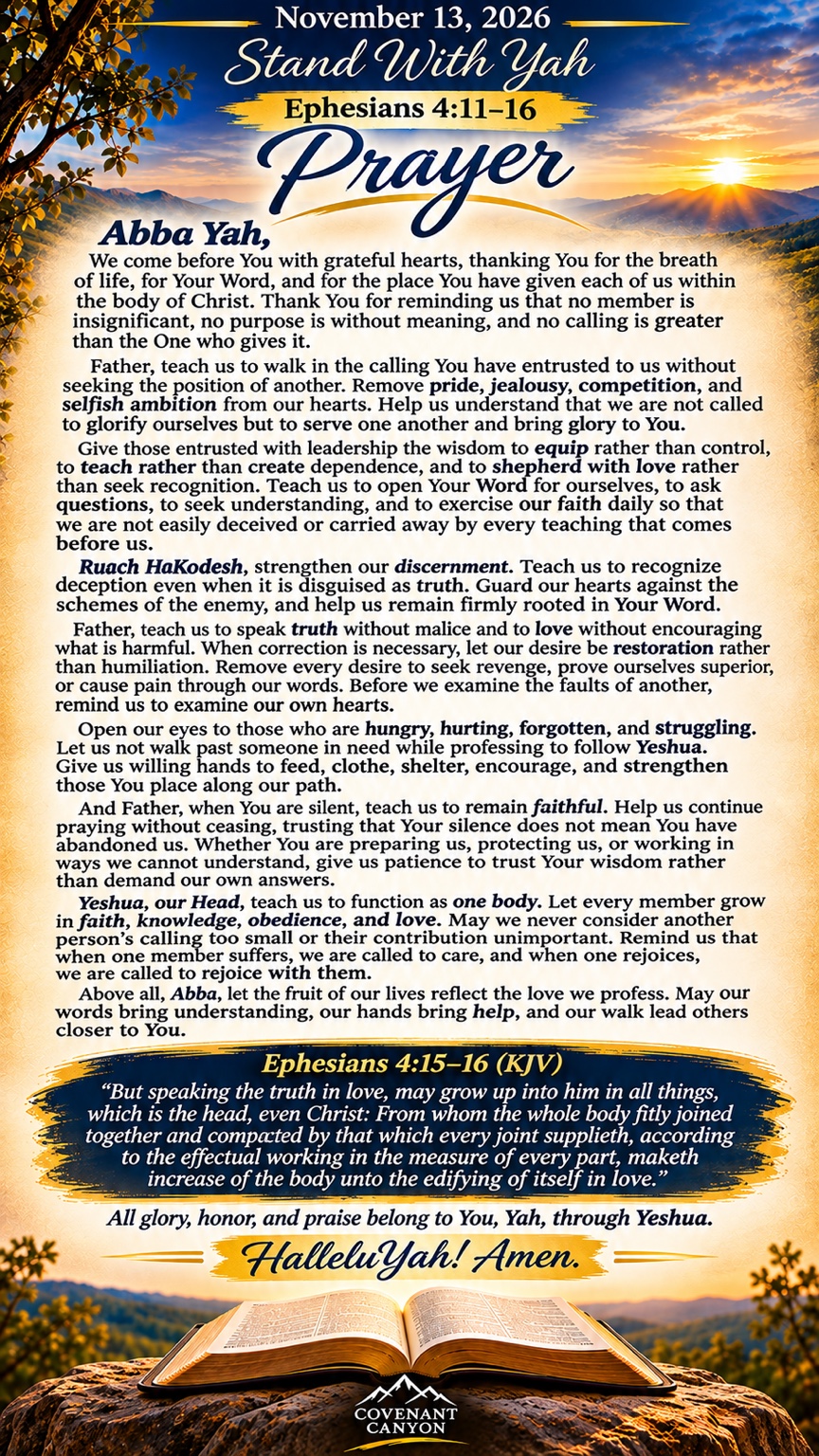
Abba Yah,
We come before You with grateful hearts, thanking You for the breath of life, for Your Word, and for the place You have given each of us within the body of Christ. Thank You for reminding us that no member is insignificant, no purpose is without meaning, and no calling is greater than the One who gives it.
Father, teach us to walk in the calling You have entrusted to us without seeking the position of another. Remove pride, jealousy, competition, and selfish ambition from our hearts. Help us understand that we are not called to glorify ourselves but to serve one another and bring glory to You.
Give those entrusted with leadership the wisdom to equip rather than control, to teach rather than create dependence, and to shepherd with love rather than seek recognition. Teach us to open Your Word for ourselves, to ask questions, to seek understanding, and to exercise our faith daily so that we are not easily deceived or carried away by every teaching that comes before us.
Ruach HaKodesh, strengthen our discernment. Teach us to recognize deception even when it is disguised as truth. Guard our hearts against the schemes of the enemy, and help us remain firmly rooted in Your Word.
Father, teach us to speak truth without malice and to love without encouraging what is harmful. When correction is necessary, let our desire be restoration rather than humiliation. Remove every desire to seek revenge, prove ourselves superior, or cause pain through our words. Before we examine the faults of another, remind us to examine our own hearts.
Open our eyes to those who are hungry, hurting, forgotten, and struggling. Let us not walk past someone in need while professing to follow Yeshua. Give us willing hands to feed, clothe, shelter, encourage, and strengthen those You place along our path.
And Father, when You are silent, teach us to remain faithful. Help us continue praying without ceasing, trusting that Your silence does not mean You have abandoned us. Whether You are preparing us, protecting us, or working in ways we cannot understand, give us patience to trust Your wisdom rather than demand our own answers.
Yeshua, our Head, teach us to function as one body. Let every member grow in faith, knowledge, obedience, and love. May we never consider another person's calling too small or their contribution unimportant. Remind us that when one member suffers, we are called to care, and when one rejoices, we are called to rejoice with them.
Above all, Abba, let the fruit of our lives reflect the love we profess. May our words bring understanding, our hands bring help, and our walk lead others closer to You.
We seal this prayer with Your Word:
Ephesians 4:15–16 (KJV)
“But speaking the truth in love, may grow up into him in all things, which is the head, even Christ:
From whom the whole body fitly joined together and compacted by that which every joint supplieth, according to the effectual working in the measure of every part, maketh increase of the body unto the edifying of itself in love.”
All glory, honor, and praise belong to You, Yah, through Yeshua.
HalleluYah! Amen.
Ephesians 4:11–16 Prayer